Emma Reed
February 27, 2026

Headaches and Your Body Clock: A Practical Daily Plan to Reduce Morning and Late-Day Attacks
If your headaches seem to show up at the same times over and over, that is not “just bad luck.” It may be a timing pattern.
Many people track headache intensity, location, and medication, but skip one variable that quietly influences all of it: your daily rhythm. Sleep timing, light exposure, meal timing, caffeine timing, movement breaks, and screen habits can all drift your body clock. When your schedule drifts, headaches can become more frequent, less predictable, or harder to recover from.
This article gives you a practical, non-medical framework for tracking and adjusting routine factors linked to timing-related headaches. It is not a diagnosis or treatment plan. Think of it as a structured experiment you can run safely, with your clinician if needed.
Why timing matters for headaches
Your nervous system runs on rhythms. Hormones, alertness, body temperature, and pain sensitivity shift across the day. That means the same trigger can hit differently at 9 AM versus 11 PM.
Examples many people notice:
- Morning headaches after short sleep, late bedtime, alcohol, or dehydration.
- Late-afternoon headaches after long screen sessions, skipped meals, and delayed caffeine withdrawal.
- Weekend headaches when wake times swing much later than weekdays.
- Travel headaches after crossing time zones or sleeping at irregular hours.
Even if you already know your major triggers, timing can amplify them. A moderate trigger at the “wrong” time may feel like a major one.
Common timing-related patterns (and what to watch)
These are patterns to observe, not conclusions to self-diagnose.
1) Sleep-window drift
Going to sleep and waking up at very different times day to day can stress your rhythm. You might still get enough total sleep but feel worse because timing is inconsistent.
Track: bedtime, wake time, sleep duration, and whether timing changed by more than 60–90 minutes from your usual schedule.
2) Light mismatch
Too little morning daylight and too much bright light at night can push your rhythm later.
Track: outdoor light in the first 1–2 hours after waking, and bright-screen/light exposure in the last 2 hours before bed.
3) Meal timing irregularity
Long gaps without food or highly variable first-meal timing can coincide with headaches for some people.
Track: first meal time, longest daytime gap between meals/snacks, and hydration pattern.
4) Caffeine timing swings
Caffeine itself may help or worsen symptoms depending on timing and dose pattern.
Track: first caffeine time, last caffeine time, approximate amount, and abrupt day-to-day changes.
5) Continuous near-work without breaks
Long blocks of intense screen focus (especially poor posture + dry eyes + stress) can build toward afternoon pain.
Track: longest continuous screen block, break frequency, and neck/eye strain rating.
The 14-day “body clock + headache” tracking setup
You do not need perfect data. You need consistent, comparable data.
Keep these daily fields
Use your headache tracker plus a quick routine log:
- Wake time
- Bedtime
- Total sleep (hours)
- Morning outdoor light minutes (before noon)
- First meal time
- Longest no-food gap (hours)
- Total water estimate
- First caffeine time + last caffeine time
- Longest uninterrupted screen block
- Movement breaks (count)
- Headache start time(s)
- Headache intensity peak (0–10)
- Medication used (if any)
- Stress level (0–10)
This sounds like a lot, but most fields are 5-second entries.
Tag each headache by timing zone
When an episode starts, tag it:
- Morning: wake to 11:59
- Midday: 12:00–16:59
- Evening: 17:00–21:59
- Night: 22:00 to sleep
After two weeks, patterns are easier to see than in free-text notes.
A simple scorecard to find your “drift days”
Give each day one point for each item below:
- Sleep start or wake shifted more than 90 minutes
- Less than 15 minutes of morning daylight
- Last caffeine within 8 hours of bedtime
- More than 5 hours between daytime meals
- Screen block longer than 90 minutes without a break
- Bedtime screen/light was bright and prolonged
0–1 points: stable day
2–3 points: moderate drift
4+ points: high drift
Now compare drift score with headache timing/intensity. You are not proving causation, but you are identifying where to test changes first.
Practical adjustment plan (start small)
Trying to fix everything at once usually fails. Use one layer at a time.
Week 1: Stabilize anchors
Focus only on:
- Wake time within a 60-minute window daily
- 15–30 minutes outdoor light in morning
- First meal within a consistent time range
Do not chase perfection. Keep it repeatable.
Week 2: Add trigger buffering
Keep Week 1 anchors, then add:
- Caffeine cutoff set earlier (example: 8+ hours before bed)
- 5-minute movement/eye break every 45–60 minutes of screen work
- Short wind-down routine with lower light at night
Then compare headache frequency and severity versus baseline.
Real-life example (how the pattern can appear)
A person logs headaches for 14 days:
- Most episodes start between 16:00 and 19:00
- High-intensity days often include:
- first meal after 13:00
- one 3-hour continuous screen block
- low morning light
- caffeine after 16:30
They do not eliminate screens or caffeine. Instead they test:
- first meal before 10:30
- breaks each hour during computer work
- no caffeine after 14:00
- 20 minutes outside before work
Over the next 2 weeks, episodes still happen but average peak intensity drops from 7/10 to 5/10, and “unpredictable” attacks become easier to anticipate.
That is useful progress, even without perfect control.
What not to do
- Do not make 8 changes overnight. You will not know what helped.
- Do not interpret one good day as proof. Look for trends over at least 10–14 days.
- Do not ignore recovery basics (hydration, meals, rest) while obsessing over one variable.
- Do not use tracker data to self-diagnose serious conditions. Tracking is for pattern awareness and discussion support.
Red-flag situations: seek urgent medical care
This article is informational only. Get urgent medical evaluation for severe or unusual symptoms, including:
- sudden “worst headache of your life” onset
- new neurological symptoms (weakness, confusion, speech/vision changes)
- headache after significant head injury
- headache with fever, stiff neck, or persistent vomiting
- a major change in your usual headache pattern, especially if escalating
If you are unsure, it is safer to get checked.
Weekly review checklist (copy/paste)
At the end of each week, review:
- Which timing zone had the most headache starts?
- What did the 24 hours before those episodes look like?
- How many high-drift days occurred?
- Did stable wake time reduce morning or evening attacks?
- Did meal timing consistency change midday symptoms?
- Did earlier caffeine cutoff help sleep and next-day pain?
- Which one change felt easiest to sustain?
- What is the next smallest useful adjustment?
This checklist keeps your process practical instead of emotional.
If your schedule is unpredictable (shift work, parenting, travel)
A perfect circadian routine may be impossible. You can still reduce chaos by keeping anchors:
- Keep wake time and first meal as consistent as your life allows
- Seek bright light soon after waking, even if your wake time changes
- Protect a short wind-down block before your sleep period
- Keep caffeine timing consistent relative to sleep (not clock time)
- Use short movement breaks during high-demand periods
In unstable schedules, “less variability” is often a realistic win.
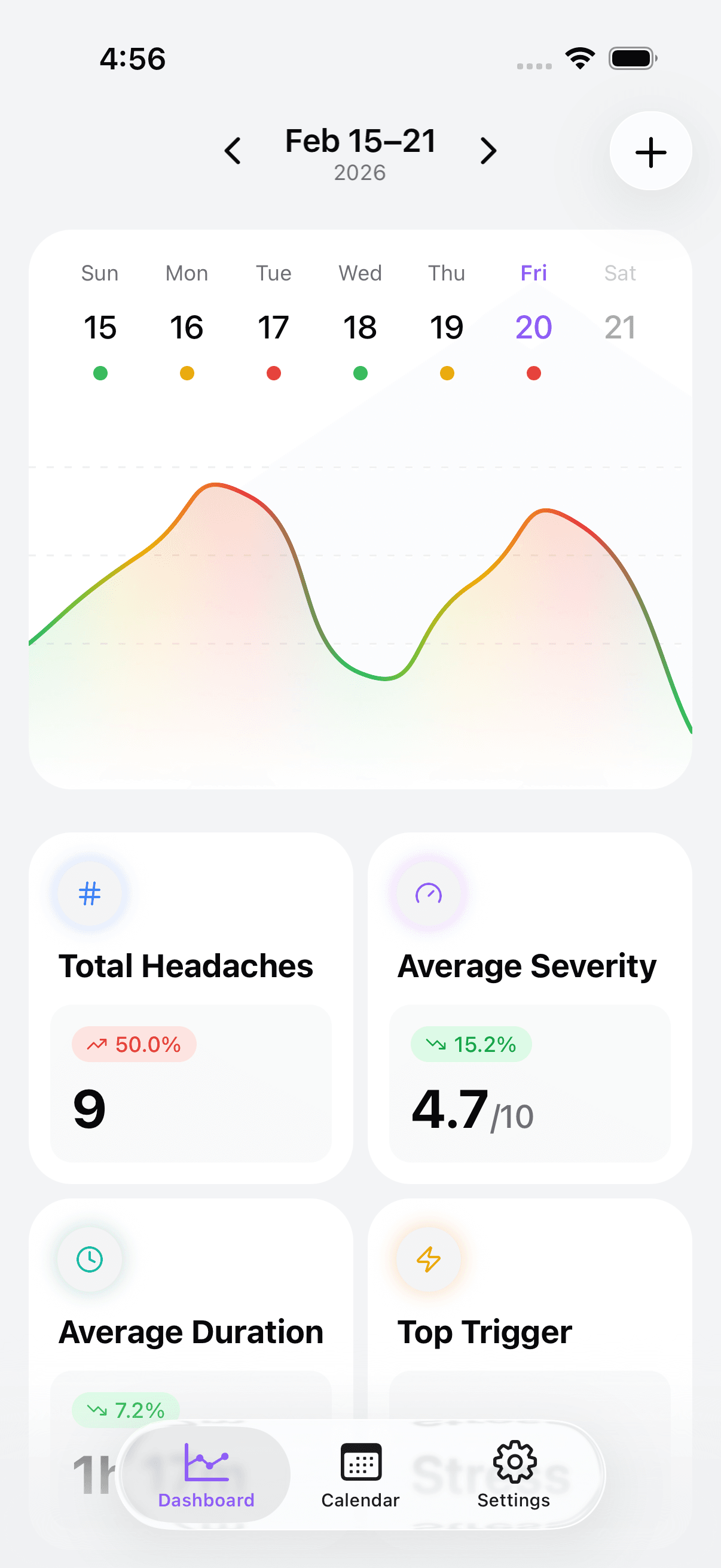
Building a sustainable routine inside the Headache Tracker app
Use app structure to lower friction:
- Save default daily fields so logging is fast.
- Use quick tags for timing zone and suspected context (screen-heavy, delayed meal, poor sleep).
- Log in real time when possible; memory later is noisy.
- Review weekly, not hourly; trends matter more than single events.
- Share concise summaries with your clinician if you need treatment changes.
The goal is not “perfect health data.” The goal is better decisions with less guesswork.
Bottom line
Headaches often feel random, but your schedule may contain repeatable signals. By tracking timing variables—sleep window, light, meals, caffeine, screen blocks, and breaks—you can identify high-drift days and test small adjustments that are realistic to maintain.
You are not trying to control every trigger. You are building a pattern-aware routine that makes bad days less frequent, less intense, or easier to predict.
Start with 14 days. Keep it simple. Let the data guide your next step.
Optional mini-FAQ
Should I stop all caffeine to test headaches?
Usually, abrupt all-or-nothing changes make interpretation harder. A steadier plan is to keep amount relatively stable for one week, then test timing adjustments first (for example, moving the last dose earlier). If you change both amount and timing at once, your data becomes noisy.
Can hydration alone fix timing-related headaches?
Hydration helps, but it is rarely the only variable. It works best as part of a routine bundle: regular meals, consistent sleep window, movement breaks, and less late bright-light exposure.
How long before patterns become useful?
Many people see early signals within 10–14 days. Stronger confidence usually comes from 3–4 weeks of reasonably consistent tracking and one-variable-at-a-time adjustments.
Take control of your headaches. Start tracking today.