Emma Reed
March 30, 2026

Desk-Job Headaches: A Practical Prevention Plan for Screens, Stress, and Long Workdays
If your head starts to throb right when your workday gets busy, you are not broken and you are not alone. Desk-job headaches are common because modern work stacks multiple stressors at once: long screen time, low movement, jaw tension, eye strain, delayed meals, too much or too little caffeine, and the subtle stress of constant notifications. None of these guarantees a headache by itself, but together they can build pressure over hours.
The useful news is this: prevention does not require a perfect routine or a dramatic lifestyle overhaul. You can lower headache frequency by making small changes in the moments where attacks usually begin. Think of it as friction reduction for your nervous system. Less strain in the neck and eyes, fewer blood-sugar swings, steadier hydration, and less "all-day clenching" often translates into fewer bad afternoons.
This guide gives you a practical plan for office days, remote days, and hybrid schedules. It is not medical diagnosis or treatment advice, and it does not promise a cure. Instead, it focuses on risk reduction, pattern tracking, and safer day-to-day habits you can actually keep.
Why desk work can trigger headaches
Most desk headaches are pattern problems, not single-event problems. A typical sequence looks like this:
- You start work focused and skip early breaks.
- Your shoulders rise, your jaw tightens, and your eyes lock on one distance.
- You delay water and meals because "just one more task."
- Stress hormones climb while posture quality drops.
- By early afternoon, pain appears and concentration falls.
That cycle can happen with tension-type headaches and can overlap with migraine patterns in people who are susceptible. Common contributors include:
- Static posture: Sitting in one position for long blocks loads neck and upper back muscles.
- Visual fatigue: Brightness mismatch, glare, tiny text, and prolonged near focus tire eye and forehead muscles.
- Inconsistent fueling: Skipped meals and rapid blood-sugar shifts can amplify headache risk.
- Hydration gaps: Mild dehydration can worsen perceived exertion and headache intensity.
- Caffeine volatility: Too much, too late, or inconsistent timing can all backfire.
- Stress carryover: Mental load translates into muscle tension and reduced pain tolerance.
You do not need to eliminate every trigger. You need enough stability across the day that your system does not drift into overload.
The "minimum effective" workday baseline
If you do nothing else, keep these five baseline habits. They are intentionally boring. Boring works.
1) Micro-break every 30 to 45 minutes
Stand up, roll shoulders, look at a far object, and walk for 60 to 120 seconds. Set a silent timer if needed. The goal is not cardio; it is interruption of static strain.
2) Eye reset rhythm
Use a simple distance reset several times per hour: look away from the screen and focus at distance for at least 20 seconds. Blink slowly a few times. Dry eyes and sustained near focus can make head discomfort escalate faster than people expect.
3) Predictable hydration
Keep water visible and easy to reach. Many people do better with small, frequent sips than big infrequent drinks. You are not chasing perfection, just reducing long dry stretches.
4) Meal timing guardrails
Avoid long fasting windows during high-focus work. A steady snack or lunch window is often more headache-protective than "I'll eat later" optimism.
5) Caffeine consistency
If you use caffeine, keep dose and timing stable day to day. Sudden spikes, very late intake, or large weekday-weekend swings can make headaches more likely for some people.
Build a headache-resistant workstation
A good setup reduces strain before motivation is required.
- Screen height: Top of monitor around eye level so you are not constantly flexing your neck.
- Viewing distance: Roughly arm's length, adjusted for text size and comfort.
- Text size/contrast: Increase font size before your face starts leaning forward.
- Chair support: Hips and back supported; feet stable on floor or footrest.
- Input devices: Keep keyboard/mouse close to avoid shoulder reach.
- Lighting: Reduce glare and harsh contrast. If possible, match room light to screen brightness.
Your workstation does not have to be expensive. It has to reduce repeated strain.
The 3-phase prevention plan (before, during, after work)
Phase A: Before work (5 to 10 minutes)
Use a short preflight routine:
- Drink a glass of water.
- Eat or plan your first meal window.
- Do 60 seconds each of neck mobility, shoulder rolls, and chest opening.
- Set two alarms: one for break cadence, one for lunch cutoff.
This is a small investment that lowers the odds of a rough afternoon.
Phase B: During work (protective loops)
Run your day in loops instead of one long sprint.
Every 30 to 45 minutes: stand, breathe, move.
Every 2 to 3 hours: slightly larger reset (3 to 5 minutes):
- Walk
- Refill water
- Relax jaw and forehead
- Quick posture check
At lunch: avoid "screen lunch" when possible. Even 10 minutes away from visual load can help.
When stress spikes: use a 90-second downshift:
- Exhale longer than inhale
- Drop shoulders intentionally
- Unclench jaw
- Soften hands
This does not remove workload. It stops stress from becoming full-body tension.
Phase C: After work (decompression)
Headaches often bloom after pushing through symptoms all day. A short decompression routine can prevent that second-wave crash:
- Light walk or mobility for 10 to 20 minutes
- Hydrate and eat if dinner is delayed
- Reduce bright-screen intensity at night
- Keep sleep/wake timing relatively stable
You are teaching your body that workday stress has an off-ramp.
What to do at the first warning signs
Early signs may include eye pressure, neck tightness, mild nausea, irritability, light sensitivity, or "brain fog." Act early and keep it simple:
- Pause for two minutes.
- Hydrate.
- Dim screen slightly and increase font size.
- Do gentle neck and shoulder movement.
- If possible, step away from visual load briefly.
- Eat a steady snack if you have not eaten in hours.
Early response is often more effective than waiting until pain is severe.
A practical tracking method (without becoming obsessive)
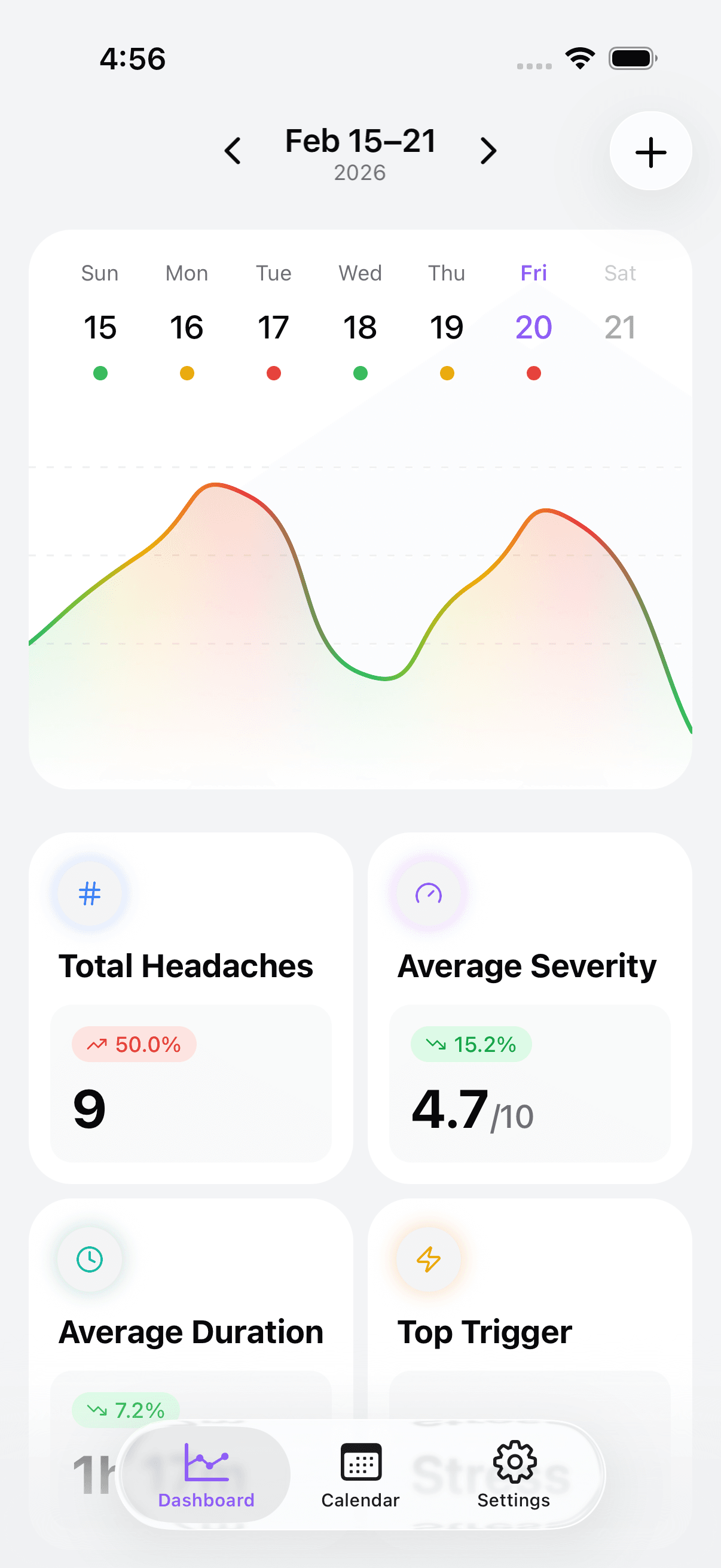
Tracking helps because memory is biased. Use your headache tracker to capture short, repeatable fields:
- Start time and end time
- Severity (0-10)
- Location/quality (pressure, throbbing, one-sided, band-like)
- Sleep quality last night
- Meal timing and hydration status
- Caffeine amount and timing
- Stress level and notable events
- Screen duration and break adherence
- Associated symptoms (light/sound sensitivity, nausea, aura)
After two to four weeks, review trends:
- Do headaches cluster after skipped lunch?
- Are they more common on high-meeting days?
- Is late caffeine linked to next-morning pain?
- Does poor sleep increase frequency?
The goal is not perfect data. The goal is actionable patterns.
Common desk-job traps (and safer swaps)
Trap: Working through mild pain because deadlines are tight. Swap: Use a 3-minute reset immediately; continue work after.
Trap: Treating water and meals as optional. Swap: Put them on calendar blocks like meetings.
Trap: Ignoring jaw clenching. Swap: Sticky note reminder: "tongue up, jaw loose, shoulders down."
Trap: Overcorrecting posture with rigid tension. Swap: Aim for "frequent posture variety" instead of military stillness.
Trap: Huge caffeine swings. Swap: Keep intake steady and avoid late-day catch-up doses when possible.
Special notes for hybrid and travel-heavy workers
Headaches often increase on transition days: office commute days, hotel workdays, or sudden schedule shifts.
Use a transition checklist:
- Pack water bottle and backup snack.
- Confirm workspace ergonomics on arrival (chair, screen height, glare).
- Do one extra movement break in the first two hours.
- Keep caffeine timing close to your normal routine.
- Protect sleep before and after travel when possible.
Transition days are not "bad luck" days. They are high-variability days. Add structure early.
When to seek medical care
Self-management is useful, but some situations require professional evaluation. Seek urgent care for sudden severe "worst headache," new neurological symptoms (such as weakness, confusion, trouble speaking, or vision loss), headache after head injury, fever with stiff neck, or a major change in headache pattern. If headaches are frequent, disabling, or increasingly hard to manage, discuss them with a clinician. Personalized assessment matters.
Your 14-day starter protocol
If you want one clear place to begin, run this for two weeks:
- Keep wake and sleep times within a consistent window.
- Use break timers every 30 to 45 minutes.
- Maintain predictable meal and hydration windows.
- Keep caffeine timing stable.
- Track headaches daily in brief notes.
- Perform a 10-minute after-work decompression routine.
At day 14, review what changed:
- Frequency n- Severity
- Recovery time
- Work disruption
Then keep what helped and drop what did not. You are building a personal operating manual, not following a one-size-fits-all script.
Final thought
Desk-job headaches are frustrating because they feel random in the moment. Usually they are not random. They are the output of repeated conditions: strain, stress, inconsistency, and delayed recovery. The upside is that repeated conditions can be adjusted. Small, boring, repeatable habits often beat dramatic one-day fixes.
No miracle claims. No cure promises. Just better odds, better data, and more days where your head is not running the schedule.
Take control of your headaches. Start tracking today.