Emma Reed
March 19, 2026

Why Consistency Beats Intensity for Headache Prevention: A 6-Week Tracking Plan for Real Life
If you live with recurring headaches, it is easy to bounce between two extremes: ignoring patterns when life is busy, then trying a perfect reset plan when symptoms spike. Most people cannot sustain the second approach for long. Work gets loud, sleep shifts, meals move around, stress piles up, and the headache diary gets abandoned after three days.
A more useful strategy is usually less dramatic: build a stable baseline first, then test one variable at a time. In other words, consistency beats intensity.
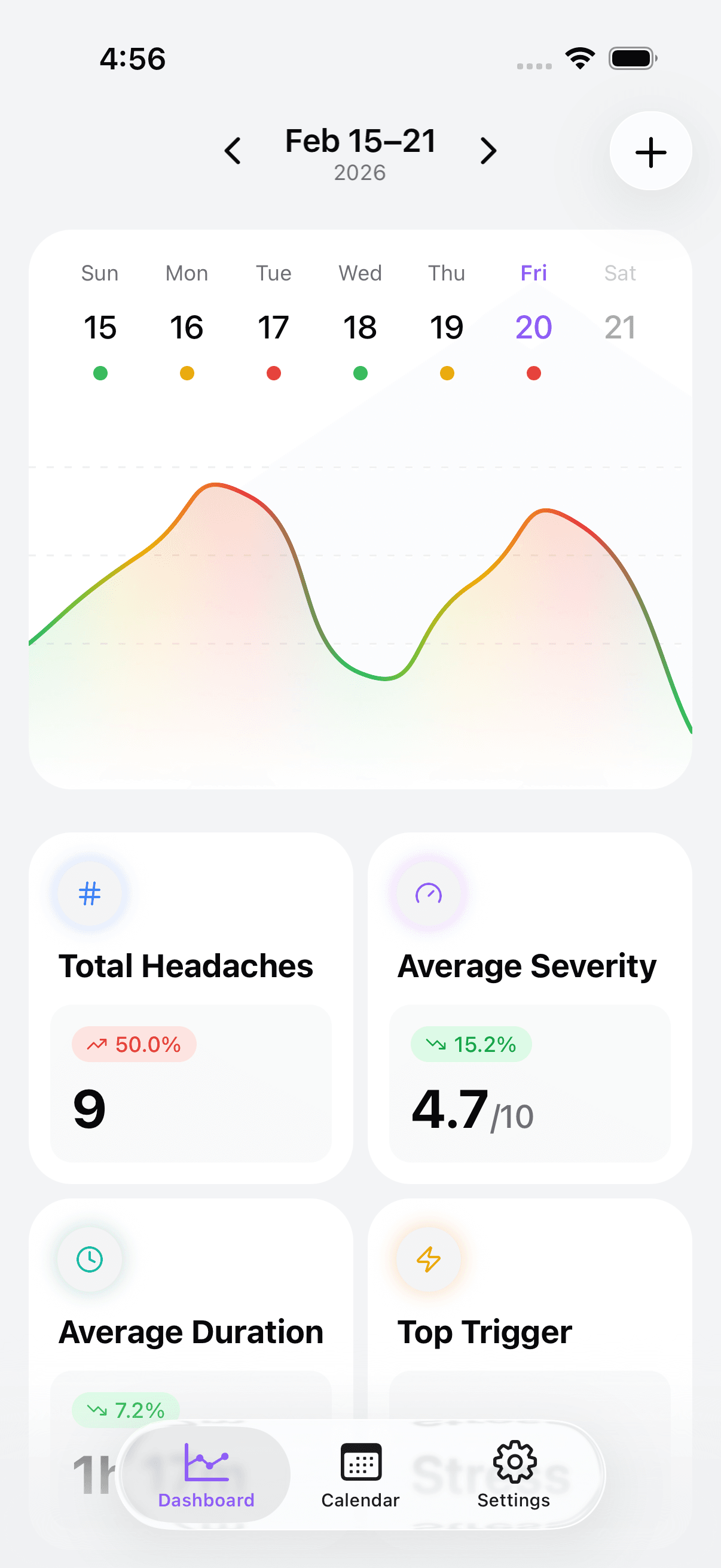
This guide walks through a practical 6-week process you can use with a headache tracker app. It is educational, not a diagnosis or treatment plan. If you have severe, sudden, or unusual symptoms, seek urgent medical care.
Why “all-in” plans often fail
Many headache plans fail for a simple reason: they ask for too many changes at once. You quit caffeine, start daily exercise, wake up earlier, drink twice as much water, stop screens at night, and try a strict meal schedule in the same week. If headaches improve, you do not know which change helped. If headaches worsen, you do not know what to adjust.
When everything changes at once, your data becomes noisy. Noisy data leads to guesswork, and guesswork leads to frustration.
A better plan:
- keep most routines steady,
- track key factors daily,
- run short experiments with one controlled change,
- review trends weekly.
This gives you cleaner signals and more realistic habits.
What to track daily (without turning it into a second job)
You do not need to track 40 fields. Start with the variables most likely to create useful patterns.
1) Headache details
Log each headache episode with:
- start time and end time,
- intensity (0–10),
- location (one side, both sides, around eyes, neck-related),
- associated symptoms (nausea, light sensitivity, sound sensitivity, aura),
- what you were doing right before onset.
Keep notes short. One sentence is often enough.
2) Sleep timing and quality
Track:
- bedtime,
- wake time,
- total sleep duration,
- perceived quality (for example, 1–5).
Headaches are often linked to sleep variability, not just short sleep. Going from 6 hours on weekdays to 10 hours on weekends can matter.
3) Hydration rhythm
Instead of obsessing over exact liters, track consistency:
- did you drink fluids through the day,
- long gaps without drinking,
- unusually high caffeine with low water intake.
Simple yes/no plus one note is enough.
4) Caffeine timing
Track:
- approximate amount,
- first and last caffeine time,
- unusual changes from your baseline.
Sudden drops or late-day caffeine can be as relevant as high total intake.
5) Meal timing
Track:
- skipped meals,
- long fasting gaps,
- very late evening meals,
- possible food suspects (only if clearly relevant).
Do not start with giant elimination diets unless your clinician advises it.
6) Stress load
Use a simple daily score (0–10) and one short context note:
- deadline pressure,
- conflict,
- travel,
- poor recovery day.
This helps separate “bad luck headache” days from high-load clusters.
7) Menstrual cycle or hormonal context (if relevant)
For people with cycle-related patterns, this can be one of the strongest signals. Keep entries simple and private.
8) Medication use
Track acute medication timing and dose. This is important for pattern awareness and safer discussions with your clinician.
The 6-week consistency plan
The goal is not perfection. The goal is reliable baseline data and low-friction habits.
Week 1: Build your baseline, change almost nothing
Your mission this week:
- log daily,
- keep routines as normal as possible,
- avoid major lifestyle overhauls.
You are creating a reference week. If tracking feels heavy, simplify the fields rather than quitting.
End-of-week review questions:
- On which days were headaches most likely?
- Was onset clustered around certain times?
- Did severe episodes follow poor sleep or long meal gaps?
Week 2: Stabilize sleep timing
Pick a realistic sleep window and hold it steady across all days, including weekends.
Target:
- bedtime and wake time variation within about 60 minutes,
- no sudden “catch-up sleep” swings when possible.
Do not aim for perfect sleep architecture. Aim for timing stability.
End-of-week review questions:
- Did headache frequency or intensity change?
- Were morning headaches less common?
- Did predictable wake time reduce “slow-start” headache days?
Week 3: Smooth hydration and meal rhythm
Keep sleep plan from week 2. Add one new focus:
- regular fluid intake through the day,
- fewer long gaps between meals,
- basic snack backup for busy days.
You are removing common “schedule stressors” that may amplify headache risk.
End-of-week review questions:
- Did late-afternoon headaches become less frequent?
- Did intensity shift on high-consistency days?
- Were there fewer headaches after long meetings or errands?
Week 4: Standardize caffeine routine
Do not abruptly quit unless your clinician advises it.
Instead:
- keep total daily caffeine near a stable range,
- keep timing consistent,
- avoid moving last caffeine much later than usual.
This week is about reducing caffeine variability, not forcing zero caffeine.
End-of-week review questions:
- Did headache onset timing become more predictable?
- Did “weekend change” headaches decrease?
- Any rebound-like days after sharp caffeine reduction?
Week 5: Add stress recovery micro-habits
Continue prior routines. Add short, repeatable recovery blocks:
- 5–10 minutes of low-stimulation breaks,
- brief breathing or walking between intense tasks,
- one screen-light wind-down routine before bed.
This is not a complete stress cure. It is a nervous-system pacing strategy.
End-of-week review questions:
- Did high-stress days still trigger headaches, but with lower intensity?
- Did recovery breaks change duration of headache episodes?
- Did fewer evenings end in escalation?
Week 6: Run one controlled experiment
Now that baseline consistency is stronger, test one hypothesis.
Examples:
- shift first caffeine 60–90 minutes later,
- add a planned mid-afternoon hydration reminder,
- enforce a no-skip breakfast week,
- cap late-night screen exposure.
Pick one experiment only. Hold other variables steady.
End-of-week review questions:
- Did the specific change improve frequency, intensity, or duration?
- Was the change practical enough to continue?
- Should you keep, modify, or discard it?
How to read your data without overreacting
Single headache days can be misleading. Look for trends across multiple days.
Useful ways to review data:
- compare weekdays vs weekends,
- compare high-consistency days vs low-consistency days,
- look at 7-day rolling averages for intensity,
- identify repeated pre-headache sequences (for example: short sleep + skipped lunch + late caffeine).
If your app allows tagging, use tags for likely contexts:
- travel,
- illness,
- high-stress deadline,
- menstrual phase,
- weather shift.
Tags help prevent false conclusions from outlier weeks.
Common tracking mistakes (and what to do instead)
Mistake 1: Tracking only on bad days
This hides what “good days” look like.
Fix: log brief entries daily, especially symptom-light days.
Mistake 2: Using vague intensity scales
If “7/10” means something different each day, trend analysis breaks.
Fix: define personal anchors. Example:
- 3 = noticeable but functional,
- 6 = need reduced activity,
- 8 = cannot continue normal tasks.
Mistake 3: Too many variables too soon
Complex logs increase dropout.
Fix: start with core fields; expand only after 2–3 consistent weeks.
Mistake 4: Ignoring medication patterns
Medication timing can strongly affect headache interpretation.
Fix: log medication use every time, including dose and relief window.
Mistake 5: Chasing certainty from one week
Headache patterns often need longer observation.
Fix: make decisions on multi-week trends, not one rough patch.
When to involve a clinician quickly
Tracking supports care, but it does not replace medical evaluation. Seek urgent care for red-flag symptoms such as:
- sudden severe “worst headache of your life,”
- new neurological symptoms (weakness, speech trouble, confusion, vision loss),
- headache after head injury,
- fever with neck stiffness,
- new headache pattern during pregnancy/postpartum,
- persistent worsening despite routine changes.
Also consider a clinical review if headaches are frequent, disabling, or if medication use is increasing.
Bring your tracker summary to appointments. Clear logs can save time and improve decision quality.
A practical weekly review template
Use this 10-minute script each week:
- Frequency: How many headache days this week?
- Burden: Average intensity and longest episode?
- Timing: Any repeated onset windows?
- Context: Most common pre-headache factors?
- Consistency score: How stable were sleep, meals, hydration, caffeine?
- Action: One small adjustment for next week.
Keep the review short. Long reviews are usually abandoned.
What “success” should look like
Success is not “never getting a headache again.” That expectation causes burnout.
More realistic success markers:
- fewer severe days,
- shorter headache duration,
- earlier intervention when symptoms start,
- better confidence about likely triggers,
- less anxiety because patterns feel understandable.
If your plan improves predictability, it is already working.
Final takeaway
If headache tracking has failed for you before, the issue may not be motivation. It may be strategy.
Instead of high-intensity resets, use a consistency-first system:
- stable routines,
- simple daily logs,
- one-variable experiments,
- weekly trend reviews.
Over 6 weeks, this approach can turn scattered notes into useful signal. That signal helps you make calmer, better decisions with your daily routine and with your clinician.
No miracle claims. No perfect days required. Just consistent inputs, clearer patterns, and smarter next steps.
Take control of your headaches. Start tracking today.