Emma Reed
April 14, 2026

Headache Tracking Without Guesswork: A Lab-Notebook Method for Finding Real Triggers
Format: lab-notebook-method
Why many headache logs fail even when people are motivated
Most people do not fail because they are lazy; they fail because the log asks for perfect memory. If you enter data only when pain is severe, your dataset over-represents bad days and misses the ordinary context that made those days possible. That produces strong opinions and weak evidence.
A useful diary behaves like a field notebook. It captures tiny details fast, at fixed checkpoints, with simple labels. The goal is not to write an essay. The goal is to reduce hindsight bias so future decisions are grounded in patterns, not mood.
The minimum viable dataset
Record five core variables every day: wake time, first caffeine time, longest screen block without a break, hydration estimate, and peak headache intensity. Five variables can feel small, but consistency beats complexity. If you cannot keep a variable for two weeks, it does not belong in your baseline set.
Add one optional variable only when investigating a specific question. Example: if you suspect skipped lunches, track meal timing for ten days. After the experiment, remove that variable unless it remains decision-critical.
Time-stamped checkpoints beat memory snapshots
Use three checkpoints: morning setup, mid-day status, evening closeout. Morning is where you capture sleep and plan constraints. Mid-day captures drift: delayed meal, glare, noise, stress spikes. Evening captures outcome. This structure separates cause from aftermath and keeps entries short.
If a headache starts between checkpoints, add a quick event note with start time, location, and what happened in the prior two hours. Avoid post-hoc novels. Three lines are enough.
How to avoid confounders
Confounders are hidden variables that move with your suspected trigger. Example: you blame coffee, but coffee happened on deadline days with poor sleep and no lunch. Without confounder notes, you eliminate the wrong thing and keep the real risk in place.
When testing one factor, keep other routines stable. If you change sleep schedule, caffeine, and exercise in the same week, you cannot attribute outcome changes safely.
A simple scoring model for real life
Create a daily load score from 0 to 8 using four binary pairs: short sleep, delayed meal, long static posture, and high sensory exposure. Each present factor adds two points. You are not building a medical diagnosis. You are creating a practical risk thermometer.
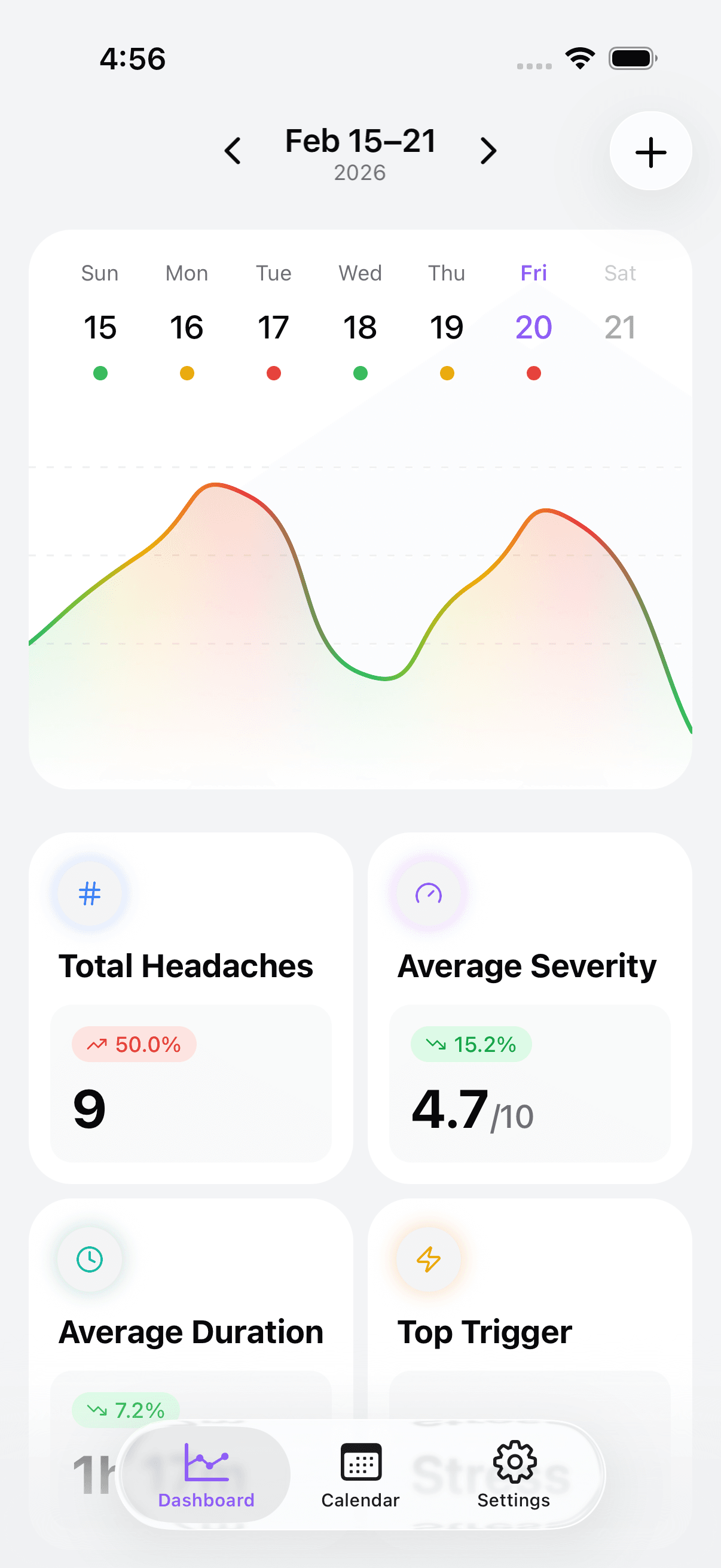
Over three weeks, compare severe headache days across low-load (0–2), medium-load (3–4), and high-load (5–8) days. If severe days cluster in high-load zones, your strategy should focus on reducing stack intensity, not chasing one magical trigger.
What to do on high-load days
Pre-commit a protective protocol: earlier hydration, lower display contrast, scheduled posture resets, and lower optional commitments. The point is not to avoid life; the point is to reduce amplification when risk is elevated.
Treat this as a seatbelt, not a cure. Some attacks will still happen. Better planning usually lowers severity and recovery time even when frequency changes slowly.
Medication logging without overinterpretation
Log medication timing, dose category, and response window. Do not declare a medicine ineffective after one rough day if you took it late during a high-load stack. Context matters.
Track monthly use totals to discuss with a clinician, especially if acute medication days are rising. The objective is safer long-term management, not self-blame.
Weekly review that takes ten minutes
Ask four questions: What preceded my worst day? What preceded my best day? Which prevention action was easiest to repeat? Which action sounded good but failed in real schedules?
Then choose one change for next week. Not five. The single highest-friction failure point gets priority. Incremental changes survive; grand overhauls usually collapse by Thursday.
Troubleshooting common data problems
Missing data streaks often mean the form is too long. Cut fields until daily entry takes under two minutes. Inconsistent intensity scores often mean anchors are unclear. Define personal anchors, such as 3 = distracting, 6 = cannot sustain focused work, 8 = mostly bedbound.
If every day looks “medium,” add one objective marker like concentration minutes before first break. Objective markers stabilize interpretation.
How to talk to your clinician using your log
Bring a one-page summary: attack frequency trend, top co-occurring risk stacks, medication use days, and any new neurological symptoms. Clinicians can act faster when data is structured.
Ask practical questions: Which red flags change my action plan? Which preventive options match my pattern and lifestyle constraints? The best care plan is medically sound and behaviorally realistic.
A 30-day implementation map
Week 1: establish baseline fields and checkpoint habit. Week 2: improve entry quality and reduce missing data. Week 3: run one focused experiment. Week 4: consolidate, simplify, and set next month defaults.
At day 30, success is not perfect symptom elimination. Success is clearer pattern visibility, earlier intervention, and fewer surprise crashes that erase your day.
Medical safety note
This article is educational and does not diagnose, treat, or cure disease. Seek urgent care for thunderclap headache, fainting, weakness, numbness, new confusion, trouble speaking, seizure, fever with stiff neck, vision loss, or headache after head injury.
Field example
A product manager noticed that headaches were blamed on coffee most often, but logs showed the stronger signal was skipped breakfast plus back-to-back calls before noon. Once breakfast and a 90-second break between calls became defaults, severe episodes dropped without eliminating coffee entirely.
A graduate student tracked only pain scores and saw no insight. After adding wake time and longest no-break screen block, a weekly pattern appeared: late-night study plus bright morning commute created predictable peaks. Small schedule shifts improved function without dramatic interventions.
A nurse on rotating shifts used three checkpoint prompts rather than free-text journaling. Data completeness improved, and treatment conversations became more specific because trends were visible by shift type.
Field example
A product manager noticed that headaches were blamed on coffee most often, but logs showed the stronger signal was skipped breakfast plus back-to-back calls before noon. Once breakfast and a 90-second break between calls became defaults, severe episodes dropped without eliminating coffee entirely.
A graduate student tracked only pain scores and saw no insight. After adding wake time and longest no-break screen block, a weekly pattern appeared: late-night study plus bright morning commute created predictable peaks. Small schedule shifts improved function without dramatic interventions.
A nurse on rotating shifts used three checkpoint prompts rather than free-text journaling. Data completeness improved, and treatment conversations became more specific because trends were visible by shift type.
Field example
A product manager noticed that headaches were blamed on coffee most often, but logs showed the stronger signal was skipped breakfast plus back-to-back calls before noon. Once breakfast and a 90-second break between calls became defaults, severe episodes dropped without eliminating coffee entirely.
A graduate student tracked only pain scores and saw no insight. After adding wake time and longest no-break screen block, a weekly pattern appeared: late-night study plus bright morning commute created predictable peaks. Small schedule shifts improved function without dramatic interventions.
A nurse on rotating shifts used three checkpoint prompts rather than free-text journaling. Data completeness improved, and treatment conversations became more specific because trends were visible by shift type.
Field example
A product manager noticed that headaches were blamed on coffee most often, but logs showed the stronger signal was skipped breakfast plus back-to-back calls before noon. Once breakfast and a 90-second break between calls became defaults, severe episodes dropped without eliminating coffee entirely.
A graduate student tracked only pain scores and saw no insight. After adding wake time and longest no-break screen block, a weekly pattern appeared: late-night study plus bright morning commute created predictable peaks. Small schedule shifts improved function without dramatic interventions.
A nurse on rotating shifts used three checkpoint prompts rather than free-text journaling. Data completeness improved, and treatment conversations became more specific because trends were visible by shift type.
Field example
A product manager noticed that headaches were blamed on coffee most often, but logs showed the stronger signal was skipped breakfast plus back-to-back calls before noon. Once breakfast and a 90-second break between calls became defaults, severe episodes dropped without eliminating coffee entirely.
A graduate student tracked only pain scores and saw no insight. After adding wake time and longest no-break screen block, a weekly pattern appeared: late-night study plus bright morning commute created predictable peaks. Small schedule shifts improved function without dramatic interventions.
A nurse on rotating shifts used three checkpoint prompts rather than free-text journaling. Data completeness improved, and treatment conversations became more specific because trends were visible by shift type.
Field example
A product manager noticed that headaches were blamed on coffee most often, but logs showed the stronger signal was skipped breakfast plus back-to-back calls before noon. Once breakfast and a 90-second break between calls became defaults, severe episodes dropped without eliminating coffee entirely.
A graduate student tracked only pain scores and saw no insight. After adding wake time and longest no-break screen block, a weekly pattern appeared: late-night study plus bright morning commute created predictable peaks. Small schedule shifts improved function without dramatic interventions.
A nurse on rotating shifts used three checkpoint prompts rather than free-text journaling. Data completeness improved, and treatment conversations became more specific because trends were visible by shift type.
Take control of your headaches. Start tracking today.